

The 2024 NAR settlement, contrary to predictions of an immediate commission apocalypse, has instead ignited a profound strategic shift within the real estate industry by attacking the razor-thin profit margins of brokerages. While agents have used off-MLS workarounds to keep average commission rates relatively stable for now, the new rules requiring direct buyer-agent negotiations and banning commission offers on the MLS have created a deep operational divide.
Large national franchises are now hamstrung by their high-overhead, inflexible business models and greater legal exposure, turning their traditional scale into a modern liability. This has created a historic opening for smaller, independent brokerages, whose agility, low costs, and freedom to innovate with flexible, hyper-local service models are now the ultimate competitive assets in a market that prizes adaptability over brand size.
A New Battlefield for Brokerages
he March 2024 settlement by the National Association of Realtors (NAR) was far more than the conclusion of a high-stakes legal battle; it was the firing of the starting pistol on a race to redefine the American real estate brokerage industry. The $418 million settlement figure, paid to resolve class-action lawsuits alleging conspiracy to inflate commissions, is a mere footnote compared to the structural upheaval unleashed by the “uncoupling” of agent compensation. As of August 17, 2024, the century-old commission system has been fundamentally altered, creating a new and uncertain battlefield for every brokerage in the nation.
The prevailing narrative that immediately followed the settlement announcement was one of impending apocalypse. Economists and industry pundits alike forecasted a cataclysmic drop in commission rates, with predictions of a 30% to 50% collapse threatening the viability of all players, big and small. This vision of a radically cheaper, consumer-driven market dominated headlines. However, the data on real estate emerging in the months since the new rules took effect paints a far more complex and nuanced picture. The ground truth reveals that while the tectonic plates of the industry have shifted, they have not shattered—at least, not uniformly.
This report will argue that the post-NAR landscape is not a uniform battlefield where all combatants face the same threats. Instead, the settlement is creating a bifurcated market where the strategic advantages are shifting dramatically. The very assets that defined success for large national franchises for decades—massive scale, ubiquitous brand recognition, and standardized systems—may now be their greatest liabilities in an environment that demands flexibility and cost efficiency. Conversely, smaller, independent brokerages, once viewed as niche players perpetually in the shadow of giants, now possess the agility, low overhead, and hyper-local focus required to thrive in this new era. The competition is no longer a simple battle of size, but a complex war of adaptability.
The New Commission Landscape – A Reality Check on the “Commission Apocalypse”
The predictions of a total commission collapse were predicated on a dramatic overhaul of industry rules. While the changes are indeed profound, their real-world application has proven to be less straightforward than anticipated. Understanding the gap between the rules as written and the market’s initial reaction is critical to grasping the true nature of the challenges and opportunities facing brokerages today.
Deconstructing the New Rules of Engagement
The NAR settlement introduced three pivotal changes to the mechanics of real estate transactions, each designed to dismantle the previous commission structure.
First and foremost is the Prohibition of Cooperative Compensation on MLS. This is the core of the settlement. The rule change eliminated the fields on NAR-affiliated Multiple Listing Services (MLSs) where listing brokers were required to advertise an offer of compensation to the agent representing the buyer. For decades, this practice was the primary mechanism that standardized buyer-agent commissions, typically at 2.5% to 3% of the sale price. By removing this field, the settlement severed the direct, public link between the seller’s listing agreement and the buyer’s agent’s paycheck, theoretically forcing a new negotiation.
Second, the settlement mandated the use of Written Buyer-Broker Agreements. Before an agent can show a property to a potential buyer, they must now have a signed agreement in place. This is not merely a formality. The agreement must explicitly and objectively state the agent’s compensation—whether as a percentage of the sale price, a flat fee, or an hourly rate—and conspicuously note that all commissions are negotiable and not set by law. This rule forces a direct, upfront conversation about value, services, and cost that was previously often obscured or avoided entirely, with many buyers incorrectly believing their agent’s services were “free” because the seller paid the commission.
Third, the rules allow for Off-MLS Negotiations. The settlement does not prohibit a seller from paying a buyer’s agent. It only prohibits the offer of compensation from being advertised on the MLS. Compensation can still be offered and negotiated through other channels, such as direct communication between brokerages, email, marketing flyers, or on a brokerage’s own website. This provision has become a key factor in the market’s initial, and somewhat muted, response to the changes.
Prediction vs. Reality: Why Commissions Haven’t Collapsed (Yet)
The initial predictions of a commission “apocalypse” were widespread and dramatic. Based on the new rules, many economists believed total commissions, which historically averaged 5% to 6% of a home’s sale price, would plummet by as much as 30% to 50%, saving consumers billions of dollars annually.
However, the reality on the ground has been far less revolutionary. Post-settlement data reveals a much more stable commission environment than predicted. A comprehensive Redfin analysis published in May 2025 found that the average buyer-agent commission was 2.40% in the first quarter of 2025. This represents only a marginal decline from the 2.43% average recorded in Q1 2024, before the settlement was announced. Similarly, data from real estate accounting software firm AccountTECH showed the average buyer-agent commission at 2.55% in January 2025, a figure identical to the rate from one year prior.
The primary reason for this resilience is the widespread adoption of an industry workaround. As a New York Times report highlighted, many agents are circumventing the “spirit” of the settlement by simply moving their commission negotiations off the MLS. Listing agents continue to press sellers to budget for a 5% to 6% total commission, and then communicate the buyer-agent portion to other agents through private channels like phone calls and emails.
This practice preserves a semblance of the old system, but it does so at the cost of transparency and efficiency, creating a more convoluted and opaque process for consumers. This fragile equilibrium, built on industry inertia and legally questionable workarounds, is unlikely to be sustainable in the long term, especially as consumer awareness grows.
A Tale of Two Markets: The Divergence in Commission Trends
While the overall average commission rate has remained surprisingly stable, digging deeper into the data reveals a significant and telling divergence based on property price. The market is not reacting as a monolith; instead, a clear fracture is emerging between the luxury and affordable segments.
In the luxury market, commission compression is a tangible reality. For homes sold for over $1 million, the average buyer-agent commission has seen a noticeable decline. According to Redfin data, it fell from 2.30% in Q1 2024 to 2.22% in Q3 2024 (when the new rules took effect), and further to 2.17% by Q1 2025. On a multi-million dollar property, even a small percentage drop translates into a substantial dollar amount, creating a strong incentive for high-end buyers and sellers to negotiate aggressively.
Conversely, in the affordable market, commissions have proven remarkably resilient and have even ticked upward. For homes sold for under $500,000, the average buyer-agent commission actually increased slightly, from 2.48% in Q1 2024 to 2.49% in Q1 2025. The logic behind this trend is rooted in buyer affordability. Many first-time and lower-income buyers struggle to save for a down payment and closing costs; adding an out-of-pocket agent commission of several thousand dollars is often impossible. Recognizing this, sellers of more affordable homes remain highly incentivized to offer buyer-agent compensation (off-MLS) to attract the largest possible pool of qualified buyers, thus keeping commission rates firm.
This divergence is the first major crack in the industry’s attempt to maintain the status quo. It demonstrates that the settlement didn’t just change a rule; it introduced a powerful new variable—the buyer’s direct ability to pay—that is fracturing the once-uniform commission landscape along price-point lines.
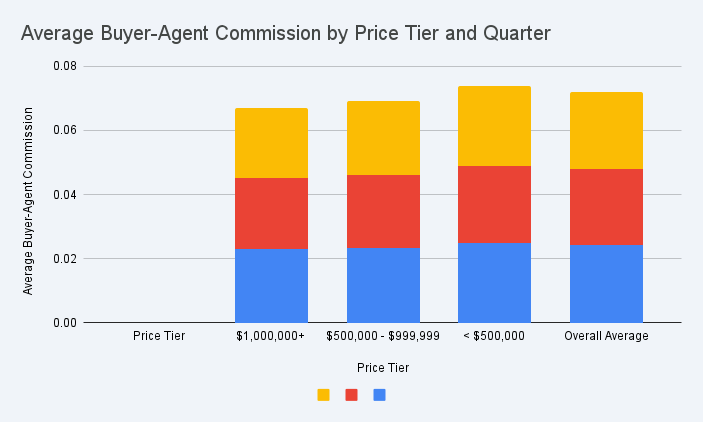
This chart shows: * The overall average buyer-agent commission was 2.43% in Q1 2024, 2.36% in Q3 2024, and 2.40% in Q1 2025.
For price tiers under $500,000, the average commission was 2.48% in Q1 2024, 2.42% in Q3 2024, and 2.49% in Q1 2025.
For price tiers between $500,000 and $999,999, the average commission was 2.34% in Q1 2024, 2.27% in Q3 2024, and 2.29% in Q1 2025.
For price tiers of $1,000,000 and above, the average commission was 2.30% in Q1 2024, 2.22% in Q3 2024, and 2.17% in Q1 2025. Source: Data compiled from Redfin and The Mortgage Point reports.
The Anatomy of a Squeeze: Why Brokerage Profitability is the Real Casualty
While public attention has focused on the modest changes in headline commission rates, the real, and far more dangerous, impact of the NAR settlement is being felt in the razor-thin profit margins of real estate brokerages. The structural changes to the market are creating a slow but powerful squeeze on brokerage profitability that threatens the viability of long-standing business models. Even a minor reduction in commission revenue can have a dramatically amplified and potentially devastating effect on a brokerage’s bottom line.
The Razor’s Edge: Unpacking Brokerage Economics
To understand the severity of the threat, one must first dissect the flow of money in a typical real estate transaction. The total commission paid in a sale, known as the Gross Commission Income (GCI), has historically been the lifeblood of the industry, typically ranging from 5% to 6% of the home’s final price. This GCI, however, is subjected to a series of splits before any profit can be realized by the brokerage.
First, the GCI is divided between the brokerage representing the seller (the listing brokerage) and the brokerage representing the buyer. This is The First Split, and it has traditionally been an even 50/50 division.
Next, each brokerage’s portion of the commission is divided again, this time between the brokerage itself and the agent who handled the transaction. This is The Second Split, and its terms vary widely based on the agent’s experience, productivity, and the brokerage’s business model. A new agent might be on a 50/50 or 60/40 split, meaning the brokerage keeps 40% to 50% of its GCI share. An experienced, mid-level agent might command a 70/30 or 80/20 split. Top-producing agents, particularly those at firms with 100% commission models, may keep nearly the entire commission in exchange for paying the brokerage a flat fee per transaction or a monthly desk fee.
After these two splits, the brokerage is left with a small fraction of the original GCI. This remaining sum, the brokerage’s gross profit, must cover all of its fixed and variable operating costs, including rent, utilities, insurance, staff salaries, marketing, technology, and legal compliance, before any net profit is achieved.
The Peril of Low Margins in a Shifting Market
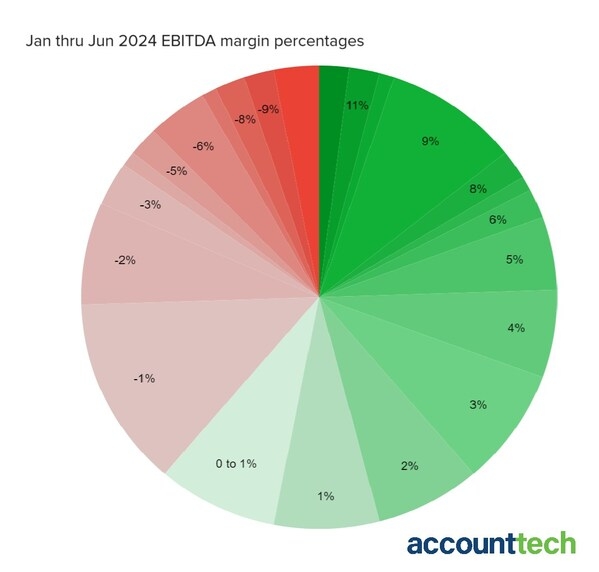
The business model described above leaves very little room for error. The real estate brokerage industry has long operated on dangerously thin profit margins. A landmark study by AccountTECH, which analyzed the performance of 100 randomly selected brokerages in the first half of 2024, revealed just how precarious the situation is. While 62% of the firms studied were profitable, their margins were alarmingly low. A mere 5% of these brokerages reported EBITDA (Earnings Before Interest, Taxes, Depreciation, and Amortization) margins above 9%, with the vast majority hovering at a fragile 3% or less.
This low-margin environment creates an amplification effect that turns small revenue changes into large profit swings. With such a slim buffer, even a seemingly minor decrease in the total GCI from a transaction has a magnified and disproportionate impact on the brokerage’s bottom line. A 0.5% reduction in the total commission paid by a consumer does not simply reduce a brokerage’s profit by 0.5%; it can easily wipe out 25%, 50%, or even 100% of the net profit the brokerage would have earned on that deal.
This dynamic is the central financial threat of the post-NAR era. As AccountTECH’s CEO explicitly warned in the study, these “slim margins may not withstand even minor reductions in commission rates”. The industry’s foundation is proving to be far more brittle than many realized. The following model illustrates this financial cascade in stark terms.
The Financial Cascade of Commission Compression (Hypothetical $500,000 Sale)
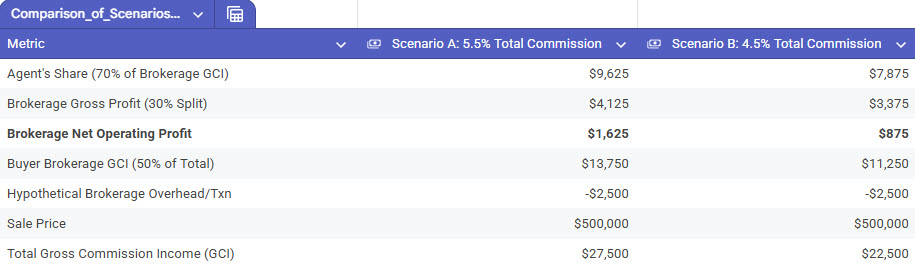
This model demonstrates the brutal mathematics of margin amplification. A 1% reduction in the headline commission rate (from 5.5% to 4.5%) results in an 18% drop in total GCI. However, after the agent’s 70% split is paid out, this translates into a staggering 46.2% collapse in the brokerage’s net operating profit for that single transaction.
This forces a critical shift in strategic thinking. In a low-inventory market, simply trying to “sell more” to make up for lower revenue per sale is not a viable strategy. The primary strategic driver for every brokerage owner in the post-NAR world must now be margin preservation. This necessitates a radical re-evaluation of every aspect of the business—from office space and staffing to technology and agent compensation—through the unforgiving lens of operational efficiency and cost control. The settlement has fundamentally changed how brokerages must be managed to survive, let alone thrive. The coming shakeout will not be driven by a collapse in revenue, but by a collapse in profitability for those who fail to adapt.
The Franchise Dilemma: When Scale Becomes a Cage
For decades, the franchise model dominated the real estate landscape, built on the power of brand recognition and national scale. However, the new market dynamics created by the NAR settlement are turning these traditional assets into significant liabilities. The large, established national franchise brokerages are now caught in a strategic trap, burdened by high costs, operational rigidity, and a business model that is rapidly losing its appeal to top-producing agents.

The Burden of the Brand: High Overhead and Inflexibility
The old value proposition of national franchises like RE/MAX, Keller Williams, and Century 21 was clear: join us and benefit from our trusted brand, national advertising campaigns, and professional brick-and-mortar office footprint. In the pre-internet era, this was a powerful competitive advantage. In the post-NAR world, it is a costly anchor.
This extensive infrastructure carries immense fixed overhead costs—including commercial rent for thousands of offices, corporate staff salaries, and multi-million-dollar marketing budgets—that are incredibly difficult to adjust in response to fluctuating revenue. When commission income per transaction is squeezed, these fixed costs remain, eating directly into the already thin profit margins of local franchise owners.
Adding to this burden are franchise fees. On top of the standard commission split that an agent has with their local brokerage, the national parent company often skims an additional 6% to 8% franchise fee directly off the top of the gross commission for every single deal. This extra layer of cost further compresses the economics for both the agent and the local franchise operator, making it even harder for them to compete on price and agent compensation with leaner, independent firms.
The Agent Retention Crisis
The settlement’s emphasis on agent-level negotiation and the need for every agent to clearly articulate their own value proposition is accelerating a crisis in agent retention for franchises. The most productive agents, who generate the majority of a brokerage’s revenue, are increasingly questioning the value they receive in exchange for the high commission splits and fees demanded by the franchise model.
This has led to a flight to 100% commission models. These alternative brokerages allow top agents to keep their entire commission in exchange for paying a flat transaction fee (e.g., $500-$1,500 per deal) and/or a modest monthly fee. For a high-volume agent, this economic difference is massive. As one broker on a Reddit forum noted, after industry splits changed, they had to lay off staff and could no longer afford to hire and train new agents, while established agents were drawn to the more lucrative 100% models.
This trend was already underway before the settlement. A 2023 report from REALTOR® Magazine noted that most of the largest franchise companies were already shedding offices and agents. The settlement has only poured fuel on this fire. The traditional franchise value proposition of “we give you leads” has been severely diluted, as nearly every brokerage now makes similar claims, and agents are realizing that their personal brand and relationships are often more valuable than the national logo on their business card.
The Liability Gap
Perhaps the most overlooked and dangerous challenge for large franchises is the unequal distribution of legal risk created by the NAR settlement itself. The agreement’s liability release, which protects firms from costly copycat lawsuits, explicitly excludes brokerage firms whose residential transaction volume in 2022 exceeded $2 billion.
This carve-out leaves the largest national players—and by extension, their franchisees—uniquely exposed to ongoing and future litigation related to commission practices. Smaller independent firms, meanwhile, are largely shielded by the settlement’s terms. This creates a significant and unbalanced legal and financial risk profile across the industry. While some of the largest companies have reached their own separate settlements, the ongoing legal exposure remains a substantial drain on resources and a major strategic disadvantage compared to their smaller, protected competitors.
The franchise model is now caught in a strategic vise. Its core assets—brand and physical scale—have become its primary cost centers. Its primary revenue generators—top-producing agents—are being lured away by more efficient and lucrative models. And its size makes it a prime target for further legal action. To survive, these giants must do more than simply cut costs; they must fundamentally reinvent their value proposition to prove that the premium they charge is worth paying in this new, unforgiving market.
The Independent’s Gambit: Agility as the Ultimate Asset
While large franchises grapple with the burdens of their own scale, a historic opportunity is emerging for the nation’s independent and boutique brokerages. The very characteristics that once seemed like disadvantages—smaller size, limited brand recognition, and a lack of national infrastructure—have been transformed into powerful strategic assets in the post-NAR world. The new market dynamics, which prize agility, cost efficiency, and hyper-local expertise, play directly to the strengths of the independent model.
The Structural Advantage: Low Overhead and Speed
The most significant competitive advantage for independent firms is their lean operational structure. Unburdened by the layers of corporate bureaucracy and mandatory franchise fees that weigh down their larger rivals, independents typically operate with dramatically lower fixed costs. Many have embraced virtual or hybrid office models, further reducing their overhead for rent and utilities. There has been no shortage of discount brokerage models that don’t require a bricks and mortar office; substantially reducing the overhead and barrier to entry. This cost efficiency is not just a minor benefit; it is a fundamental structural advantage. It allows them to be profitable at commission levels that would be unsustainable for a high-overhead franchise, giving them immense pricing flexibility in a market that now demands it.
Beyond cost, independents possess the critical asset of speed. A boutique broker-owner can observe a shift in their local market on Monday, devise a new pricing strategy on Tuesday, and implement it across their firm on Wednesday. This ability to pivot and adapt in real-time is a feat that is simply impossible for a large, bureaucratic franchise, where changes can take months or even years to filter down through the corporate hierarchy. In a rapidly evolving environment, this nimble decision-making is a decisive advantage.
The Freedom to Innovate
Freed from the rigid constraints of a franchise agreement, independent brokers have the autonomy to experiment with and perfect the very business models that are disrupting the industry. They are the natural laboratories for innovation in compensation and service delivery.
This includes offering a full spectrum of tailored compensation models. An independent can seamlessly offer clients a choice between a traditional percentage-based commission, a 100% commission model with a flat transaction fee, salaried agent services, or even an “à la carte” menu where savvy consumers can purchase only the specific services they need, such as MLS listing, contract negotiation, or closing coordination. This flexibility directly addresses the consumer demand for choice and transparency that lies at the heart of the settlement.
Furthermore, independents are perfectly positioned to cultivate a hyper-local brand. In a world where commission is negotiated on a case-by-case basis, a brand built on deep community knowledge, personal reputation, and a track record of local success can be far more powerful and persuasive than a generic national logo. They can own the “local expert” niche in a way that a franchise, by its very nature, cannot.
The New Competitive Arena
The NAR settlement has fundamentally altered the terms of competition. By removing cooperative compensation offers from the MLS, it has diminished the value of the MLS as a gatekeeper of critical financial information. The competitive focus is irrevocably shifting from which brokerage has access to the system to which brokerage can most effectively articulate and deliver value to the consumer.
This new arena is ideal for agile independents. They can build a brand and a service model that speaks directly to the core principles of the settlement: transparency, negotiation, and consumer choice. Their challenge is no longer about surviving in the shadow of giants, but about leveraging their inherent advantages to lead the market.
The NAR settlement did not just level the playing field; it tilted it in favor of those who are quickest on their feet. In doing so, it inadvertently created the ideal market conditions for the rise of the independent brokerage, transforming them from “small firms” into prototypes for the successful brokerage of the future.
Strategic Pathways to Profitability in 2025 and Beyond
The post-NAR landscape is not a death sentence for all brokerages, but it is a death sentence for complacency. Survival and success in this new era will require a clear-eyed assessment of a brokerage’s core strengths and the ruthless execution of a chosen strategy. The “mushy middle”—the brokerage that is neither a hyper-efficient, low-cost provider nor a high-touch, indispensable value-add partner—is the model most destined for extinction. Two distinct playbooks are emerging for the industry’s two dominant archetypes: the national franchise and the agile independent.
The Franchise Playbook: Re-Justifying the 30%
For large national franchises, the path forward involves leveraging their immense scale to provide value that independent agents and smaller firms simply cannot replicate. The goal is no longer to justify their existence through brand recognition alone, but to become an indispensable technology, training, and business-support partner that makes their commission split and fees an undeniable bargain for their agents.
- Radical Operational Efficiency: The first step is to aggressively attack the high-overhead model. This means reducing physical office footprints, centralizing back-office functions, and fully embracing the virtual and hybrid work models that were proven effective during the pandemic.
- Build an Unbeatable Tech Stack: Franchises must go far beyond offering a basic CRM. They need to invest heavily in developing a proprietary technology stack that provides a clear competitive edge. This includes AI-powered lead generation and qualification, predictive analytics to identify likely sellers, and fully automated transaction management platforms that save agents dozens of hours per deal.
- Become an Elite Education & Coaching Powerhouse: The value proposition must shift from basic sales training to high-level business coaching. Franchises should focus on helping their agents become better entrepreneurs—teaching them financial management, team building, and personal branding. This should be supplemented with elite-level marketing support, creating sophisticated campaigns for agents that they could not create on their own.
- Leverage the Brand for Ancillary Services: The trusted national brand name is a powerful asset for launching and integrating high-margin ancillary businesses. By building or acquiring robust mortgage, title, insurance, and even property management divisions, franchises can create new and more stable profit centers to offset the inevitable compression in commission revenue.
The future of brokerage profitability is about making a clear strategic choice and executing it with extreme prejudice. The industry is re-sorting itself into two viable camps: low-cost, high-volume efficiency machines and high-touch, high-value strategic partners. Attempting to be both is a recipe for failure.
Adapt or Perish in the New Gilded Age of Real Estate
The landmark NAR settlement of 2024 did not trigger the immediate commission collapse that many predicted. Instead, it has acted as a powerful catalyst, accelerating underlying market trends and exposing the profound economic fragility of the traditional real estate brokerage model. The initial data reveals an industry grappling with change, clinging to old habits through inefficient workarounds. However, the long-term trajectory is undeniable: the pressure on brokerage profit margins is immense, unrelenting, and will reshape the entire competitive landscape.
The analysis clearly indicates that the post-settlement era is not a uniform crisis but a period of strategic divergence. The competitive advantage is decisively shifting from sheer scale to operational agility, creating a historic opportunity for independent brokerages to outmaneuver their larger, more rigid franchise counterparts. The very foundations of the franchise model—high fixed overhead, brand-based value, and standardized systems—are being tested like never before. Meanwhile, the inherent strengths of independents—low costs, speed, and the freedom to innovate—are perfectly aligned with the demands of a more transparent and consumer-driven market.
This shift, however, does not guarantee victory for the small and nimble. It merely changes the rules of engagement. Success for any brokerage, regardless of size, will now be determined by strategic discipline and a relentless focus on executing a clear value proposition. Franchises must become indispensable technology and service partners to justify their cost structure. Independents must become hyper-specialized, ruthlessly efficient, and culturally magnetic to attract both clients and top talent.
The coming years will be a period of intense competition, consolidation, and innovation. Brokerages that cling to the pre-settlement status quo, hoping for a return to the old ways, are destined to become obsolete. Those that embrace transparency, redefine their value in the eyes of both consumers and agents, and execute their chosen strategy with precision will not only survive but will lead the industry into a new, more dynamic, and ultimately more consumer-focused era. The great uncoupling of commissions is also the great unbundling of the brokerage itself, and in this new Gilded Age of real estate, only the most adaptable will be left standing.